Methods Overview
Methods document the processes, frameworks, and operating models your team follows — structured approaches that can span multiple documents and be referenced across your work.
Overview
A Method is a named process or framework: something like "Agile Workflow," "Go to Market Plan," or "OKR Planning." Unlike skills — which are flat, single-document capabilities — Methods are hierarchical. A Method can contain child documents, letting you build out a detailed process tree where the top-level document describes the overall approach and children capture specific steps, phases, or reference material.
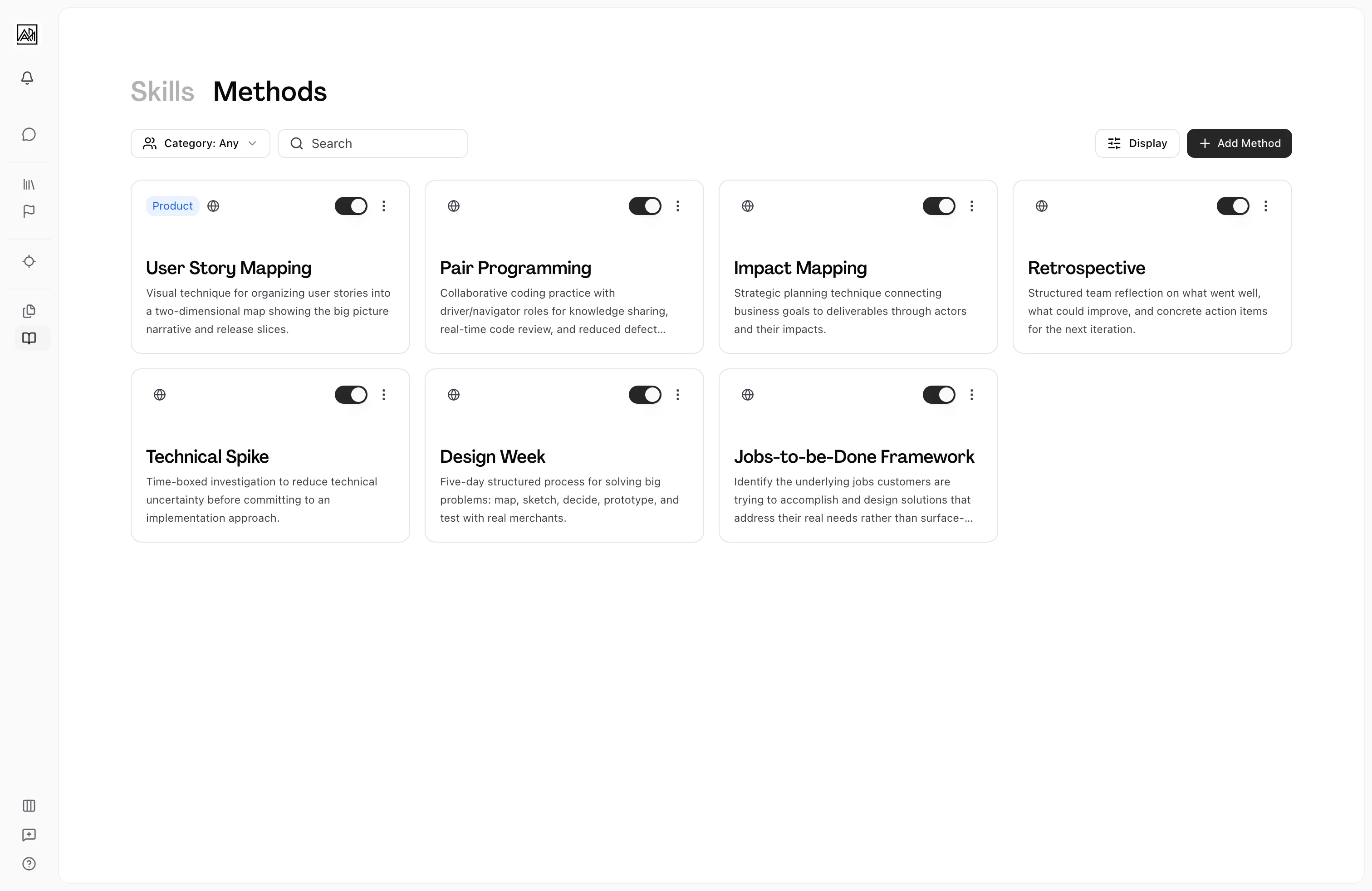

Methods are the closest thing in Hamster Studio to an internal wiki for how your team operates. When you document your hiring process, your sprint cadence, or your design review criteria as Methods, Hamster Studio can reference that context when helping you Plan and deliver work.
Methods and Skills share the same navigation — you move between them using the Skills and Methods tabs at the top of the page. Chat can draft a Skill and then a Method around it; review each draft before creating it. See Skills Overview for the full sequence. Hamster also ships a small set of pre-built Methods through the Methods Library that any team can enable on day one — see "The Methods Library" below.
This feature may need to be enabled for your workspace.
How It Works
-
Open the Methods tab — Navigate to Methods in your workspace sidebar. You see all top-level Methods currently in your workspace.
-
Add a Method — Click "Add Method" to open the creation dialog. You provide a title, an optional description, and an optional category.
-
Open a Method to write — Click any Method card to open the document editor. The left sidebar shows the full document tree for that method. You write in the main content area using the rich text editor.
-
Add child documents — Inside the tree sidebar, click the add icon next to any document to create a child beneath it. Children inherit the same editor experience. You can nest as deeply as your process warrants.
-
Navigate the tree — The sidebar collapses on smaller screens and can be toggled manually. Breadcrumbs in the header always show your current location within the hierarchy.
-
Activate or deactivate — Like skills, each Method card has a toggle switch. Inactive Methods are stored but not referenced by Hamster Studio. New Methods default to active.
-
Edit or remove — Use the overflow menu on a card to edit the title, description, or category, or to remove the Method from your workspace.
Key Capabilities
-
Hierarchical structure: Methods support parent-child document nesting. A top-level Method can have as many children as needed, and each child can have its own children, forming a tree.
-
Tree navigation sidebar: When you open a Method, a collapsible sidebar shows the full document tree. You can navigate between documents, reorder them by dragging, and create new children without leaving the current view.
-
AI chat panel: The Method editor includes an AI chat panel alongside the document. You can ask questions about the Method, request improvements to the content, or use the chat to think through changes before writing them.
-
Real-time collaboration: Multiple team members can view the same Method simultaneously. Participant avatars appear in the header and updates are reflected live.
-
Card and table views: The Methods list supports the same card and table display options as Skills, with identical sort, group, and filter controls.
-
Category labels: Methods use the same six categories as Skills — Product, Ops, Experience, Development, Marketing, and Workflows.
The Methods Library
The Methods Library is a curated set of pre-built Methods that ship with Hamster Studio. Open /library in your workspace to see what's available. Each library Method comes with a bundle of associated skills, and turning the Method on for your account turns those skills on with it.
You interact with library Methods in two ways:
-
Enable for your account. Toggle a library Method on directly. It becomes active for your workspace with its bundled Skills, without saving a copy. Fork it only when you want an editable version. Toggling off restores the default state — nothing is lost. Library Methods you've enabled show up alongside your own Methods on the Methods page, marked with a "from Library" badge and locked for editing.
-
Fork into your workspace. If you want to customize a library Method, click "Fork". Hamster copies the Method and every bundled skill into your account, where you own them and can edit them freely. The forked copy is yours — Hamster never touches it again. Forking automatically disables the library card so it doesn't compete with your edited version in the UI. Forks are permanent divergences; if the library Method updates later, your fork doesn't change.
The library evolves as Hamster ships new opinionated methods. v1 includes the Hamster Method (the lightweight loop Hamster itself uses to refine and align on Briefs) and gstack (a fuller Delivery framework). More are on the way.
How Methods Differ from Skills
| Aspect | Skills | Methods |
|---|---|---|
| Structure | Flat — single document | Hierarchical — parent with children |
| Navigation | No sidebar tree | Tree sidebar with full document hierarchy |
| AI chat | Not shown | Available alongside the document |
| Typical use | A specific capability or Task type | A process, framework, or operating model |
A useful rule of thumb: if you are describing a single, discrete thing your team does, it is probably a skill. If you are describing a multi-step process that warrants sub-documents or reference material beneath it, it is probably a method.
Tips
- Use Methods for things that require explanation at multiple levels of detail. For example, a "Hiring Process" Method might have children for "Job Description Template," "Interview Rubric," and "Offer Letter Guidelines."
- The tree sidebar auto-collapses on screens narrower than 1280px. If you are on a laptop and do not see the sidebar, look for the collapse toggle in the left edge of the document area.
- When adding a Method from a template, the template provides the title, description, and category. You then fill in the actual content for your team in the editor.
- Keep top-level Method titles short and recognizable. Team members will encounter these names in the AI chat context, so clarity matters more than completeness at the top level.
- Try the library before authoring from scratch. Enabling Hamster Method or gstack gives a new team a coherent set of skills to work with on day one — fork later if and when you need to customize.